Saturday, 26 November 2011

City: task

The Flatiron Building

Our task it to analyse and compare the six images bellow which are all of the flatiron building. This sky scraper is located in Manhattan, New York city and was completed in 1902. There were mixed reactions to the building at the time.

Edward Steichen:


This image of the Flatiron building was taken by Edward Stiechen in 1905. The main focus point of this image however is not of the building but the scene below. This makes the image similar to Coburn and Stieglitz's photos as the building is also not the main focus. The foreground is high contrast so the attention is brought to the foreground which suggests that the is putting forward a message about society at the time and a sense of class in the area in which the building stands.

Alfred Steiglitz:


This image was taken in 1903, just one year after the completion of the building. There were mixed reactions to the building but by the way this is photographed you can assume that Steiglitz was in favour of the Flatiron. The building is in the background of the image and the detail is lost in the mist. This give the illusion that the building it quite subtle and therefore has not imposed on the city.


Alvin Langdon Coburn:


This image taken in 1912 is similar to Steichen's in the way that there is a street view which bring focus to society surrounding the building at the time. Coburn has photographed business men dressed professionally and the fact that this is out of focus is presumably to represent the pace of the city. 


Walter Gropius:


Walter Gropius took this photo in 1928. This image is the first so far to look at the buildings structure as apposed to it surroundings. Berenice Abbot also has a similar approach when photographing the Flatiron building. The angle is what is most intruiging about this image compared to the others as it draws attention to the height and shaping of the building.

Walker Evans:


Walker Evans's image of the Flatiron building taken in 1926 is very different to the other in the way that the building is the main focus, however only a small section has been photographed. This image is more of a composition of the building and architecture and objects surrounding it. It is also the only image that is taken in colour which could be said to be a more modern approach to photographing the building.


Berenice Abbott:


This images was taken by Berenice Abbot in 1938. The building is the main focus of this image as it is in Gropius's and is also in focus.both images look at the building as an architectural piece and present the structure. The main difference between the images is the angle. Although both are shot looking up as if the building is looming over you slightly, here the building is photographed upright. This is more accurate to how the building would actually seen when approaching it whereas it seems Gropius is making a slightly more artistic statement.

Wednesday, 16 November 2011

Body: Jeffree Star

Jeffree Star

Jeffree star is a Dj, singer songwriter and model that has his own clothing range. I have used to have an interest in his music in my early teens and felt that he would be perfect to look at for this project. He is said to have work his mothers make up from a young age and began to cross dress properly in his teens. This led to his becoming a make up artist and started to build his profile as a model. His music career started with his self released electronica/ hip hop music with explicit lyrics on myspace. social networking made him very popular and he would frequently blog about his self image and would display many images of himself. These images were both self taken and professionally shot. By doing this he would boost his profile


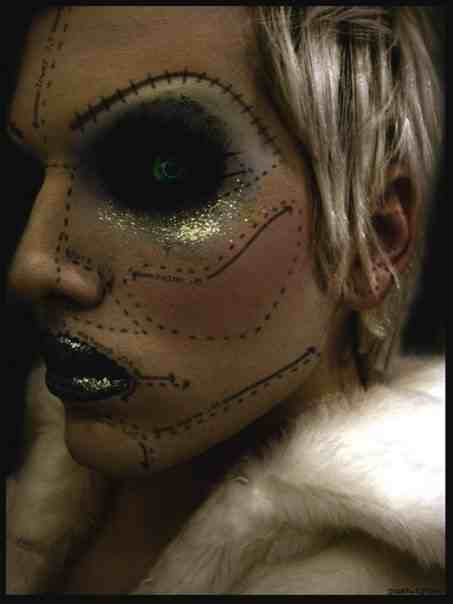
I have chosen to look at the two images above for the same reason. They both show the process of what Star has had to do to get the result of how he looks not. It is similar to the way that Warhol was not subtle about showing the fact that he was a man dressed as a woman. Star has had a lot of surgery on his face to make himself appear 'beautiful' and to give him more feminine features.This story is told in the first of these images with the drawing on the face that are meant to mimic the markings drawn just before plastic surgery.

In the second image He is wearing a wig but an incomplete one where the bald cap and sections of hair are clearly visible. Jeffree star often refers to himself a fake in his music and presents the elements of him that are 'fake' with pride. This is shown in this image as it is quite clear that his hair is not real but is still vibrant. 


Jeffree star always tries to come across as glamorous which is quite typical of transvestites, drag queens etc. To take on a female persona many features much be enhanced or changed such as wearing fake eyelashes, drawing on new eyebrows and wearing wigs. This can look quite extreme when put all together on a man but but Star embraces this and in his photos he will have accessories like gucci bags and sunglasses to seem glamorous. The image above is more classic as he has chosen a jemmed fascinator with a veil and feathers.I think having feminine accessories within these images enhances his appearance and could maybe transfer this idea into my portrait. 


Because Jeffree star promoted himself mainly on networking sites like myspace and facebook he uploads a lot of images that he has taken of himself as many people do. This caught my attention because these images are more intimate. They are taken by him either in his room or dressing room by himself and are personal in the way that this is how he wishes to present himself to the public. I could achieve this same effect in my portrait images by having the models arm outstretched to the camera as if they are taking the image of themselves. This would then be showing that this is how they are choosing to present themselves.

Body: Andy Warhol

Andy Warhol


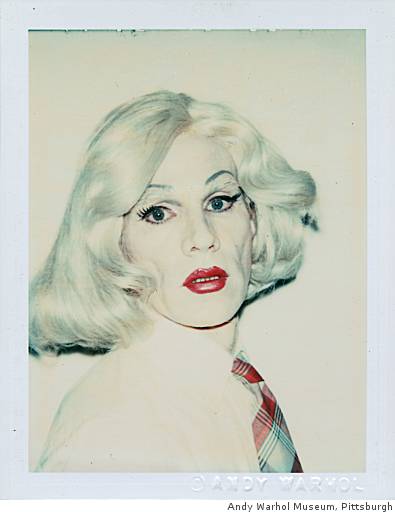
Andy Warhol is a very celebrated photographer that is famous for his pop art style, celebrity portraits and also his self portraits. In the early 80's Warhol collaborated with photographer Christopher Makos. They worked on a series of self portraits of Warhol in drag. He had an ongoing interest in drag queens  and in general the aspect of artificial role play which you could even say  he looked at in his celebrity images of people such as Marilyn Monroe.


This series was not about revealing ones self it was about presenting a mask. I find this idea of creating a new identity for yourself very intruiging. Men dress as women for different reasons but Warhol has decided not to focus on a female alter ego or a reasoning for the the change in appearance. He is exposing the vulnerability of feeling to need to present yourself in a way to mask who you are. 


The image above is slightly different to the others within the collection. He is not trying to trick the observer into believing that he is a women which could be said for the image below. He has deliberately included his broad masculine shoulders in the photo and his lack of breasts is also obvious. The angle of the camera makes his heavy set jaw quite prominent aswell which is a feature that is thought to be very manly.

I think the he has photography this in this way to make it very blatant that he is a man impersonating a women to reinforce the fact that a front is being put on.


Warhol Has used a plain white backdrop for all of his images within this series which is think I may choose to mimic when I do my own portrait for this project. It means that all of the focus is draw to the model and it work particularly well when he wears bright lipstick and bold wigs as seen in the image above. Also the whitening of the face draws attention to the brightly coloured sections of the image which are the fake elements that create his new persona.

Tuesday, 15 November 2011

Body: Brief and ideas

Brief:

For this project we are required to explore portraiture. We have to find someone to model for us that we are not friends with so this can be a random person off the street, a friend of a friend etc. This is quite a daunting task however will be a good experience as we will not develop as photographers if we limit ourselves to just taking photos of our friends. There has to be a reason why we have chosen the person that we are going to approach. This can be a general interest in a person and what they do or they may just fit the criteria of the idea that you wish to base your work on.


Ideas:

I was excited by this project as I love photographing people. I was unsure as to which direction I wanted to take this project however. I knew that I wanted to look at 'the surface' weather that was stripping the surface by photographing someone without any make up or glamourisation but in their raw form or by photographing someone in the superficial form.
If I chose to take a raw approach then I shall look at photographers like:

-Malcolm Veinville


-Corrine day


-Paolo Roversi


If I decide to go to the other extreme I want to look at drag queens. I have always found them fascinating and will allow me to explore alter egos and performance. I am most likely to look at photographers such as:

Andy Warhol:


Curently this is the only potographer that comes to mind but will look into this topic in more depth if i take this idea further.

City: Trip to london

Francesc Torres
As a group we visited the Imperial war museum. This trip was very appropriate for my 'City' project within the second part of my study of environment photography. I am going to carry on with the work that i started about the effects of WW2 in London that was not suitable for the landscape project.

The first photographer that we looked at was Frances Torres. His exhibition 'Memory Remains' Was a collection of 150 projected images to mark the 10th anniversary of the attacks on september 11th. The images were of items and materials that were recovered from the World Trade Centre after the attaccks. 
 

The items photographs range from personal belongings to steel girders and burnt out viacles. These were all stored at hanger 17 at JFK international airport. This was a personal project for Torres as he lived only two blocks away from the twin towers and had to watch the destruction. He said that there was an emotional power of what remained and that 'though remains of history memory remains' which beautifully sums up the intentionas of this exhibition. 
 

Although i did not find the images within this exhibition asthetically pleasing i could fully appreciate the point that they were making. I feel that its is very admirable to photograph the remains as a mark of respect because although the even has ofcourse not been forgotten, by photographing the remains this shall remain remembered. I personally found the images of peoples personal belongings most emotional because it bring to light the realisation that although many died they were individual people.

This links to my project idea as i hope to look images of remains from the bombings in the 1940's. This idea however is not as emotional as Torres's work as this is about looking to the past and capturing the remains so that the momory is not lost. With my project I want to look at the development and how London has been reconstructed since then.


Don McCullin


The other exhibition that we looked at was Don McCullin 'Shaped by War'. McCullin was a photojournalist and was sent to document wars and conflicts across the world in places like Vietnam, Lebanon, Cyprus, Berlin and Cambodia. His powerful collection is shocking but is to show the 'truth of war'.
McCullin put his life in danger on a regular basis as he would live in the same conditions as the solidiers and to be able to take his photos he would have be be amongst the fighting and gunfire. One thing that gave me a great respect for this photographer is that he said that it felt good to feel pain as he was photographing others pain as he had clearly been injured over the years due to the nature of his work. Although this may seem slightly insane it shows his great respect for thoses that he was photographing. His work is quite intrusive in the way that he is capturing people on their death beds and in moments of extreme despiration and i feel that the only way that he has managed to do this in a repectful manor is by  becoming a part of what he is photographing and completely surrounding himself in these situations.

The image above was of a family after the news of a death of a family member.McCullin has managed to capture an extremely raw moment. I think this is what makes his images so powerful.
When human beings are suffering, they tend to look up, as if hoping for salvation. And that’s when I press the button."- Don McCullin. To me this quote shows that although he can never predict what is about to happen, his images are well thought out and intentional.


Saturday, 15 October 2011

Induction to colour printing

Induction:

For our colour printing induction i chose to use my photos that i had taken in our focal length and perspactive workshop. In the workshop the task was to take an image that was accurate and then an experimental image with a perspective that would destord the book in the image.


This is my negative of my 'accurate' image after ide scanned it in.


This is the negative of my 'destorted'. 


I choses my accurate image to develop. Here is my block test of the image.


I chose to expose the image for 10 seconds. 
Cyan = 0
Magenta = 60
Yellow = 80


I decided that first print out was too magenta. This is fixed by increasing the magenta.
10 second exposure
Cyan = 0
Magenta = 70
Yellow = 80


The image was then too green so i had to turn the magenta down.
8 second exposure
Cyan = 0
Magenta = 67
yellow = 80

 
This was my first full print but the magenta needed to be taken down slightly
8 second exposure
Cyan = 0
Magenta = 67
Yellow = 80


Here is my final print!
 8 second exposure
Cyan = 0
Magenta = 65
Yellow = 80

Induction to studio:

In our induction we were told about various types of studios, filma and paper, We also looked at health and saftey such as trip hazards, the heat from the lighting, ect.
The aim of the session was to experiment with exposure, aperture and shutter speed.


Here are my negatives from the shoot. We photography a piece of cloth changed the aperture and shutter speed with every shot.


This is the contact sheet which allowed me to to look back at my notes that i took during the shoot and see how the changing of shutter speed and aperture had effected the photos.


We started the printing process by doing a block test where the image is exposed in stages of 5 seconds to show a scale of increased exposure.


I chose to to expose the image for 15 seconds on grade 2.


I decided that the white was too white and detail in the cltoh was being lost so i exposed the image for 5 seconds on grade 0 and then 10 seconds on grade 2.


The blck in the image was not defined enough so to make the black blacker i exposed the image for 5 seconds on grade 0, 10 seconds on grade 2 and then 10 seconds on grade 5.


This is my final test strip before printing the full image.


After printing the full image i realised the black still needed more defintion.


This is my final image!